
3D & CBCT imaging
For implants, wisdom teeth and anything a flat X-ray cannot show enough of.
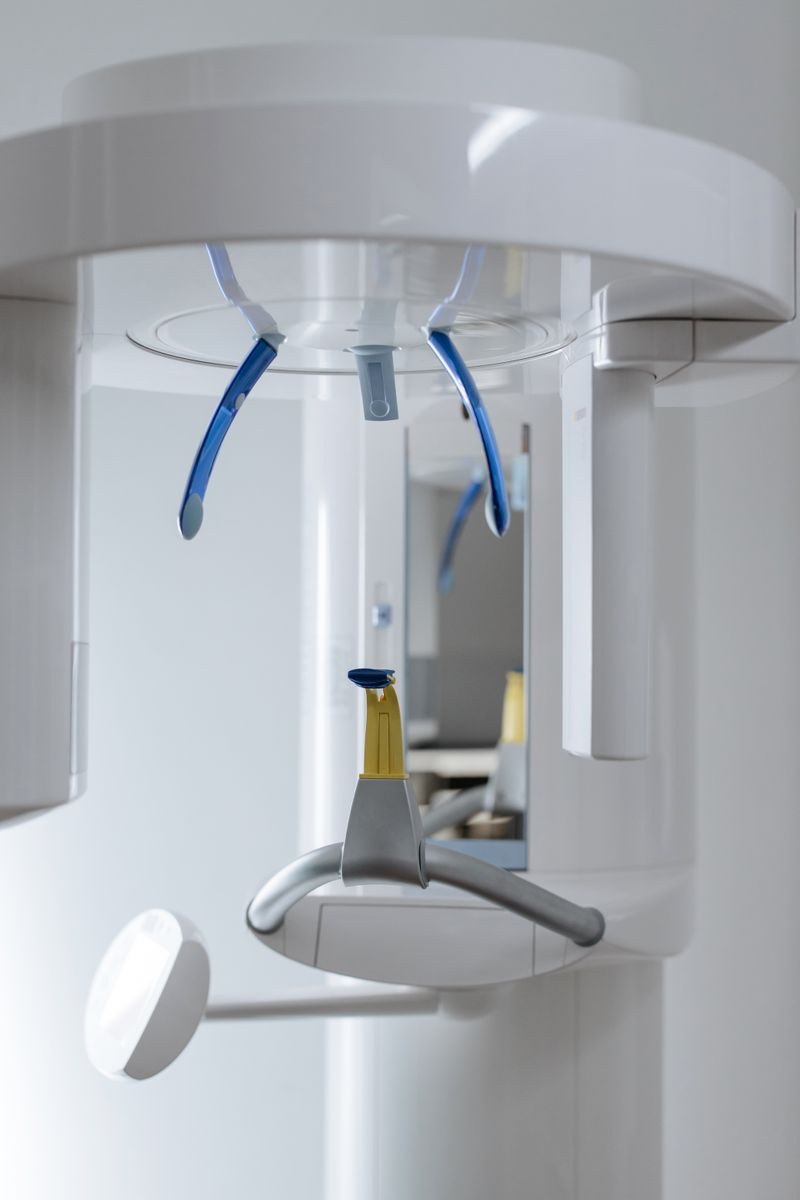
A cone beam scan (CBCT) travels once around your head and builds a three-dimensional picture of your teeth, jaws and sinuses. Dr. Malik uses it before surgery, when a flat X-ray cannot show how thick the bone is or where a nerve runs.
What we use it for.
- Planning an implant, where the width and height of bone decide whether one can be placed.
- Removing a lower wisdom tooth whose roots sit close to the nerve in the jaw.
- Checking the sinus above an upper back tooth before a graft or an implant.
- Finding an extra or sharply curved root canal that a flat X-ray has not shown.
- Looking at an impacted tooth in a teenager to see which way it is pointing.
From your side of the chair.
-
01
Deciding on a scan
A CBCT is not part of a check-up. Dr. Malik orders one when a specific question about bone, a nerve or a sinus has to be answered before treatment.
-
02
Chin on the rest
You sit or stand with your chin on a small rest and a light strap across your forehead. You close your lips and hold still.
-
03
One slow turn
The arm travels once around your head and the scan is over in well under a minute. Nothing goes in your mouth and nothing touches your teeth.
-
04
Looking at it together
The scan comes up as slices Dr. Malik can move through. He turns the screen and shows you the tooth, the bone and the nerve he is working around.
-
05
Planning from the scan
An implant position is worked out on the scan before surgery is booked. You hear what he found, what he plans, and what he would do if the bone is thin.

What it costs, and who pays.
A scan is short, and it is often taken at the consultation visit rather than on its own day. Plans treat CBCT differently from ordinary X-rays: some cover part of it when it is taken for implants or surgery, and some do not cover it at all. We check your plan before the scan is booked.
Ask for a written estimate3D & CBCT imaging, answered.
What is the difference between a CBCT scan and a normal dental X-ray?
A normal X-ray is flat, so structures sit on top of each other. A CBCT is three-dimensional, so bone can be measured and a nerve or sinus can be seen where it actually is.
Is there more radiation in a 3D scan?
More than a single dental X-ray, and less than a medical CT scan of the head. It is taken when the answer it gives changes the treatment, not as a routine image.
Is the machine like an MRI? I am claustrophobic.
No. You stay upright and in the open, and the arm turns around your head for less than a minute. Tell us you are claustrophobic and we walk you through it first.
Do I need a 3D scan before an implant?
For most implants, yes. It is how the bone gets measured before the day of surgery, so the implant is planned to fit rather than judged on the day.